
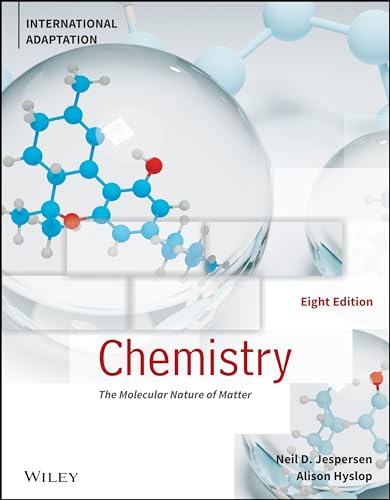
Chemistry : the molecular nature of matter / Neil D. Jespersen and Alison Hyslop ; with significant contributions by James E. Brady
Material type: TextPublication details: Singapore : Wiley, 2022.Edition: Eighth edition International adaptationDescription: xxiv, 1118 pages : illustrations ; 28 cmContent type:
- text
- unmediated
- volume
- 978-1-119-82064-2
- Cir./540/J581
 Circulation
| Cover image | Item type | Current library | Home library | Collection | Shelving location | Call number | Materials specified | Vol info | URL | Copy number | Status | Notes | Date due | Barcode | Item holds | Item hold queue priority | Course reserves | |
|---|---|---|---|---|---|---|---|---|---|---|---|---|---|---|---|---|---|---|
 Book |
DSSC LEARNING RESOURCE CENTER General Stacks | Circulation | Cir./540/J581 (Browse shelf(Opens below)) | Available | 009981 | |||||||||||||
|
Circulation
|
DSSC LEARNING RESOURCE CENTER Processing Center | Circulation | Cir./540/J581 (Browse shelf(Opens below)) | c. 2 | Available | 011287 |
Browsing DSSC LEARNING RESOURCE CENTER shelves,Shelving location: General Stacks,Collection: Circulation Close shelf browser (Hides shelf browser)

|

|

|

|

|

|

|
||
| Cir./530/T413 Fundamentals of physics / | Cir./530/Y841 Cutnell & Johnson physics / | Cir./530.071/R724 The big ideas in physics and how to teach them : teaching physics 11-18 / | Cir./540/J581 Chemistry : the molecular nature of matter / | Cir./541.28/H529 Modern quantum chemistry / | Cir./547/C37/2020 Organic chemistry / | Cir./547/K641 Organic chemistry / |
Includes appendices and index.
Contents: A Very Brief History of Chemistry -- Scientific Measurements -- Elements, Compounds, and the Periodic Table -- The Mole and Stoichiometry -- Molecular View of Reactions in Aqueous Solutions -- Oxidation-Reduction Reactions -- Energy and Chemical Change -- The Quantum Mechanical Atom -- The Basics of Chemical Bonding -- Theories of Bonding and Structure -- Properties of Gases -- Intermolecular Attractions and the Properties of Liquids and Solids -- Mixtures at the Molecular Level: Properties of Solutions -- Chemical Kinetics -- Chemical Equilibrium -- Acids and Bases: A Molecular Look -- Acid-Base Equilibria in Aqueous Solutions -- Solubility and Simultaneous Equilibria -- Thermodynamics -- Electrochemistry -- Nuclear Reactions and Their Role in Chemistry -- Metal Complexes -- Organic Compounds, Polymers, and Biochemicals.
"The eighth edition of our textbook continues to emphasize the molecular nature of matter, strong problem solving, and clarity of writing that was the basis of the seventh edition of Chemistry: The Molecular Nature of Matter by Neil D. Jespersen and Alison G. Hyslop. In this edition, the relationship between the molecular level and the observable macroscopic properties of matter is presented in detail to reinforce and expand this fundamental concept. Learning chemistry requires work, and practical study skills are presented at the beginning of every chapter to help organize this work. Additional problemsolving questions which integrate scientific practices, cross-cutting concepts and chemistry core ideas to relate the ideas presented in each chapter to the wider fields of science"-- Provided by publisher.
There are no comments on this title.